
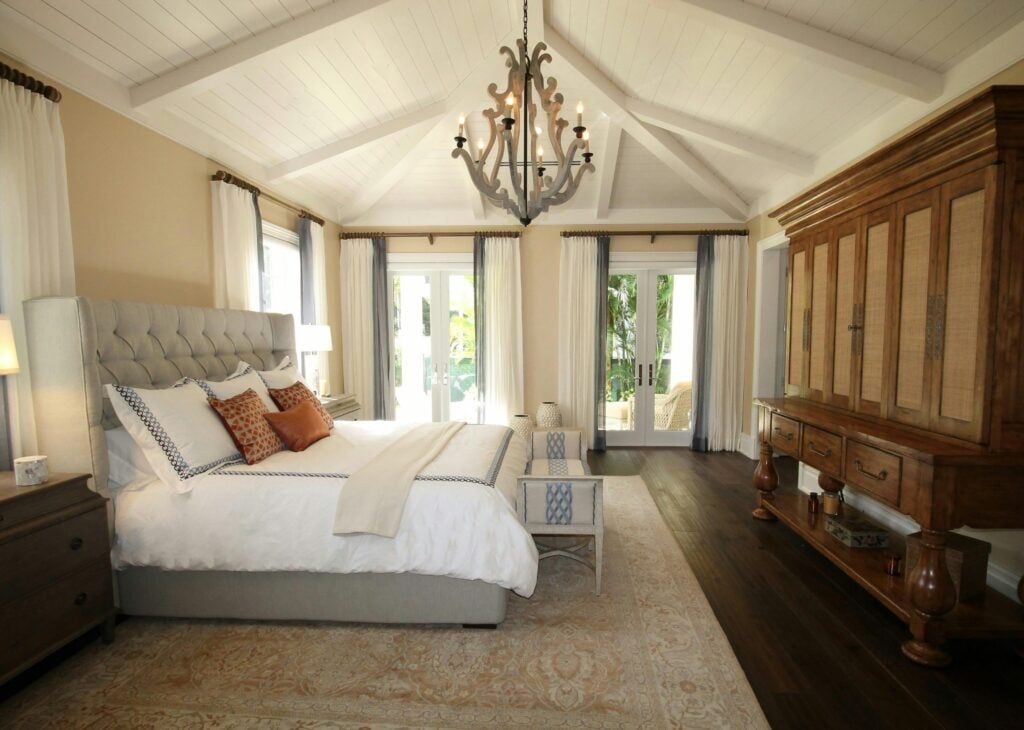
Most bedrooms look restful at first glance – soft colored cushions, maybe a candle on the side. Your real test isn’t what it looks like. It’s about what the room does when the lights go out. Its airflow, temperature, and echo noise. It’s the way sound moves, the way the light sneaks in under the door.
You don’t notice these things until you can’t sleep, then they’re all you notice.
Architects talk about the behaviour of a space – how light falls, how it holds heat, how sound travels. And that is exactly what shapes your nights. Not just the decor, but the invisible structure behind the room.
Orientation Matters More Than Style
Did you know that where your bed sits in relation to light, noise, and air flow can impact your rest? North-facing rooms stay cooler longer. South-facing ones catch the warmth and glare. You can’t change a house’s compass, but you can work with it.
If sunlight floods the room too early, blackout blinds help—but so does hanging thicker-lined curtains on just that one window.
Morning light is fine; it’s the inconsistency that stabs your sleep routine.
Beds pushed against external walls can also feel cold, especially in older homes; moving them inwards even half a metre helps stabilise temperatures. And there is something psychological about the positioning of your bed. Apparently, your body relaxes when it can see the door. It’s things like this that are good to know.
Airflow and Temperature
Stale rooms don’t let you sleep. You feel it – the heavy thick air that won’t move. You need a fresh air supply even for a short time to keep CO2 from building up overnight, which will help you stop waking up with that groggy feeling.
Try opening a window for 20 minutes before bed to let fresh air circulate. If you can’t do that, try using a fan to move air around without blasting cold drafts into your bedroom.
Thermal layering can also help you out – a light duvet plus a throw, not one heavy cooler.
The ideal temperature for sleep hovers around 65°F, which is cooler than most people have their rooms at night.
A good test is: if the air feels sharp against your body, but you are warm inside the covers, that’s about right.
Don’t forget your flooring, too. Carpets trap heat, wooden floors breathe. Layer wooden floors with rugs so you can control the temperature, not fight it.
Quiet The Room’s Shape
Sounds don’t just come through the walls; they bounce throughout the space. Bare walls and wooden floors create small echoes that amplify every creak.
Bedrooms with minimal furniture are often the loudest. And the best way to rectify this is to add soft furnishings.
Curtains that touch the floor, upholstered chairs or bedframes, and even extra cushions work. All the fabric can help to break up sound waves and stop the room from feeling like an echo chamber.
If you live near a busy road, check your windows and ensure they’re sealed to block out excess noise. Draft tape or acoustic film can be extremely effective. On top of this, you can shift furniture strategically or add curtains that help dull some of the noise for a quieter bedroom.
Manage Light
What we mean here is to look at it from an architectural standpoint, not a decor one. By understanding how light defines spaces, sets boundaries, and directs the eye, you can work with it to control how it affects your sleep at night and your brain.

Ceiling fixtures can often glare too much, and this means you might prefer to use softer lighting, like floor lamps or wall lighting, to avoid this.Light temperature below 3,000 K can help increase melatonin, which means blue light tones are out and warmer light temperatures are in.
Don’t overlook the little details like the standby light on your TV, the street lights coming through gaps in the curtains, or the light display on devices in the bedroom, even faint hues cue wakefulness.
Another tip is to position the bed near the switches so you can avoid getting up to turn lights off or even use a smart feature to turn them off via voice control.
Scent, Texture and Design
Good design for bedrooms doesn’t scream it; it builds before you notice it. Scent works in the same way, too. Under the radar, subtle but effective.
The key here is familiarity, choices that make sense to you. The same applies to texture, too. You want linen that wrinkles and flooring that feels soft and comforting like the range from Antipodean Home, made to be breathable and to help you get a more relaxing night’s sleep.
These changes can make a massive difference; how your bedroom smells, how it feels to the touch, and the combination of texture and design make the move from styled to settled, and this is what you need to aim for.
Keep It Pure
Your bedroom needs to be your room for sleep. It shouldn’t double up as a nursery, laundry room, storage area, etc. While this might be practical, especially for smaller homes, it’s confusing for your brain when you try to sleep, and it’ll feel anything but relaxing.
Where possible, separate working and sleeping areas. Fold clothes somewhere else. Draw the line. Create the barrier, your bedroom should have one message: sleep. If space forces an overlap, you need to create a visual division. A screen, a curtain, a panel, or even a change in flooring to signal the separation and allow you to split the room’s function effectively.
And Silence
To finish off your relaxing room, never underestimate the power of silence. Less is more in the bedroom. You want a quiet bedroom that hums at a low frequency – the thud of a neighbor’s door closing muted by fabric or the low whirr of air moving around the room.
That’s when you can see all your design choices at work and know it’s doing what you need it to. And that is the beauty of architecture and what it really means for a restful night’s sleep.

No Comments